Testing The Waters
New models of river flow are helping countries to share their water more fairly
by: Helen Pilcher
You can learn a lot about a country by listening to its music. Take the songs of Ethiopia. Many mention the Blue Nile, a major tributary to the Nile River, which rises in the country’s highlands before winding through Sudan and then Egypt. Some songs portray the river as a source of pride and joy. They refer to it as Abay, the “great river” or “father of rivers.” In others, however, the Nile is depicted as a neglectful parent or a traitor that has betrayed its people.
These mixed messages exist because of historical agreements, carved over the last century, which allocated all of the Nile’s waters to the downstream nations of Egypt and Sudan. Ethiopia, which contributes over 85% of the river’s flow, has been prevented from using it – a bitter pill for a country that has suffered from repeated drought and famine. Nor is Ethiopia alone. The Nile passes through eleven countries. The same treaties that prohibited Ethiopia’s access, have also prevented the eight other upstream countries from utilizing the resource. “This created an entrenched sense of inequity among the riparian countries that still lingers to this day,” says Ethiopian-born water scientist Mekdelawit Deribe.
Complicating matters further, Egypt and Sudan are resistant to change because they rely heavily on the Nile River for most of their fresh water. Now upstream nations are challenging the treaties. They are building dams and calling for the water to be shared more equitably, but there’s just one problem. No one can agree what equity looks like, nor how to best achieve it. Transborder water management is a pressing global issue. Around 60 per cent of the world’s freshwater flows across national borders.
There are over 300 transboundary river basins, shared by over 150 countries, yet most countries don’t cooperate with each other to manage the resource. This is problematic because the unilateral actions of one country have consequences in others. Pollution flows downstream. Dams built in one place affect water flow in others. Water-dependent sectors, such as agriculture, industry and energy, feel the knock on effects, as do the people who depend on their services. Geopolitical tensions simmer.
In the Nile River Basin, it’s clear the status quo isn’t working, but the obvious solution – to allocate shares of water to each of the eleven countries, based on population, land area and other factors – doesn’t work either. Deribe has modelled this scenario and found it’s a dead end. “If we did this, some of the countries, especially those downstream, would not be able to live off their shares in the long term,” she says.
So, Deribe has another suggestion, inspired by the nature of rivers. Rivers pay no attention to international borders or the countries that they pass through. They just flow, from their source at one end, to their mouth at the other. So, instead of thinking about the water allocation to each country, Deribe prefers to consider the entire Nile River Basin as a unit.
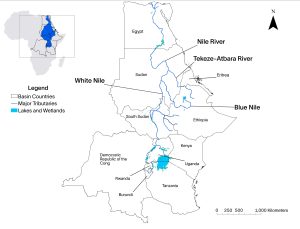
During her PhD at Florida International University, Deribe has built a model that projects how various influences, such as social, economic and climate-related factors, will impact the basin. She has found that in most scenarios, by 2050, climate change will increase rainfall in parts of the basin. More water will flow through the Nile, but demand for this water will also grow. Considering the basin as a whole, however, makes this situation more manageable. “If water is allocated according to demand, and countries use what they need, rather than hoarding reserves, we can have a sustainable future, at least up to 2050,” she says.
This will require countries collaborating to generate basin-wide policies. Ethiopia, for example, is well suited to hydropower because of its steep terrain and cooler climate. So instead of building more hydroelectric dams in countries with less amenable geography, it makes sense to build them in Ethiopia, where it’s estimated the technology could produce 45,000 megawatts of power. “That’s more than enough to power the entirety of the Nile Basin,” says Deribe. Agriculture could also be restructured. Instead of planting thirsty crops in desert regions, agriculture could be prioritized in fertile cooler areas, where there is less evaporation and more rainfall. “Considering the basin as a unit allows you to entertain these kinds of options,” says Deribe. Northeast Africa isn’t the only part of the world to face this sort of challenge.
Thousands of kilometers away, Jordan is also struggling with its water supply and the transborder diplomacy that surrounds it. Jordan, which is one of the world’s most water scarce countries, is part of the Yarmouk River Basin. The Yarmouk flows through Syria, Jordan and Israel. In recent decades, Israel and Syria have both adopted unilateral policies that benefit themselves but reduce the water flow to Jordan. Syria, for example, has constructed more than a dozen dams along the Yarmouk River.
In addition, many thousands of ground wells – regulated and otherwise – have been sunk. The wells enable people to draw water from underground reserves called aquifers, but the aquifers also help to recharge the river. Now, they are less able to do this. The dynamics of the river have changed.
Across the same time period, Jordan has hosted millions of refugees. The population has grown from around 2 million in 1980 to around 11 million in 2025. As the demand for water increases, Jordan is forced to rely primarily on the groundwater from its aquifers. Jordanians receive a delivery of water to their homes, once a week.
In the United States, people use around 300 litres of water per day. Jordanians receive the equivalent of 50 to 90 litres per person per day. If their water runs out, they must pay for more. “Because of this, Jordanians tend to be very aware of every drop of water they use,” says water scientist Rania Al-Zou’bi. Now, the aquifers are becoming depleted faster than they can replenish, and a severe water crisis is expected.
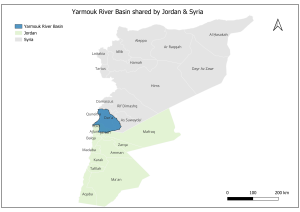
Al-Zou’bi, who born in Jordan and worked in the water sector for over 15 years, is completing her PhD on transborder water management at the Delft University of Technology in the Netherlands. Like Deribe, she is trying to find ways to make sharing more equitable, but instead of focusing solely on supply and demand, Al-Zou’bi is adding in a third factor – economics.
She too has modelled the different ways that water could be allocated in her native river basin, but by adding in economics, she is able to ask a vital question – what incentives can a downstream country like Jordan offer to an upstream country like Syria to encourage them to share? The model enables Al-Zou’bi to input different policies and predict possible outcomes. For example, suppose Syria and Jordan agreed to an agricultural policy, where Syria produces more rain-fed crops, such as olives, and fewer irrigated crops, such as peach trees. This would free up river water for the Jordanians, who in return would agree to import more olives.
Or suppose that Jordan installs more solar farms and exports more energy to Syria, which desperately needs it after its war torn past. This would give Jordan leverage to negotiate its water supply from Syria, based on the economics of these energy exports. For now, these suggestions are hypothetical. The model is under development. Once completed, Al-Zou’bi will be able to present these scenarios to Jordanian policy makers and other stakeholders, along with suggestions for economically viable, bilaterally beneficial, evidence-based policies. Think of it as a water-based trade market.
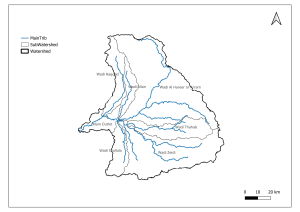
According to Al-Zou’bi, this sort of thinking has not been incorporated into Jordanian policies. “Every country with a shared water resource thinks the same way,” she says. Myopically, within the confines of their own border, and in silos, where sectors such as water, energy and agriculture are considered separately. “This needs to change,” she says. “What we are trying to do as researchers is to freeze the bilateral conflicts, the tensions, the asymmetries of power, and say let’s focus on economic opportunities, not just technical or institutional challenges.”
From the Africa to the Middle East, good science is vital if water is to be shared equitably, but the models of Deribe and Al-Zou’bi aren’t restricted to their native basins. They can be adapted to generate practical solutions and policy suggestions for other river basins too. The biggest challenge, however, may not be generating policy suggestions, but persuading people to adopt them.
Deribe’s suggestion to consider the Nile River Basin as a unit, for example, has already met with some resistance. In downstream Egypt and Sudan, some are concerned that the scenario would erase their historical stronghold, says Deribe. Whilst in upstream countries, some worry the approach would whitewash over rather than redress past inequities. From policy makers to the people who live on its banks, the Nile stirs mixed feelings. With their dichotomous themes of ‘treasure’ and ‘traitor’, the songs of the Nile reveal these feelings, but they also reveal something else.
In 2011, Ethiopians took their water supply into their own hands and began building the Great Ethiopian Renaissance Dam. The impressive structure, which is 145 metres tall and 1,800 metres long, holds 74 billion cubic metres of Nile River water, and generates more than 5,000 megawatts of power. It took 14 years to build and has become a source of enormous national pride. Deribe noticed that after construction began, song lyrics about the Nile started to become more favourable.
Negative themes dissipated. Previously notable critics of the river seemed to soften. This, she says, is indicative of an attitude shift. People across the Nile River Basin are becoming more open to new ways of managing the Nile, raising hopes that in time, equitable sharing of its waters will become possible. There is one song in particular, which sums this view up. It is by The Nile Project, a collaborative musical collective featuring musicians from all 11 countries in the Nile River Basin. In Ya Abai Wuha (Waters of the Nile), they sing, “If we have love and peace, it’s more than enough for all of us.”
Contributors
Mekdelawit is a Faculty for the Future Fellow committed to advancing the equitable and sustainable management of the Nile River. She is currently pursuing a PhD in Earth Systems Sciences at Florida International University.
Rania is a Faculty for the Future Fellow and an expert in water–energy–food nexus governance, dedicated to advancing sustainable and cooperative resource management in transboundary basins. She is currently pursuing a PhD in Civil Engineering at Delft University of Technology (TU Delft).